
What Is the Monthly Cost of Waiting?
(June 2026)
Waiting Feels Safe. Until it isn’t.
Right now, a lot of business owners are in wait-and-see mode. You may be one of them. Waiting on hiring. Waiting on investing. Waiting on replacing systems. Waiting on AI. Waiting on expansion. Waiting for interest rates to settle down, for the economy to feel more predictable, or for uncertainty around technology and AI to become clearer.
On the surface, that feels responsible. Preserve cash. Avoid unnecessary risk. Do not move too quickly. And to be fair, there are legitimate reasons to be cautious right now. Costs continue to rise. Technology keeps changing. Customers are behaving differently. The business environment seems to shift constantly.
As a result, many businesses hesitate before making decisions. That hesitation is understandable. However, there is another side to waiting that often gets less attention.
Waiting has a cost too.
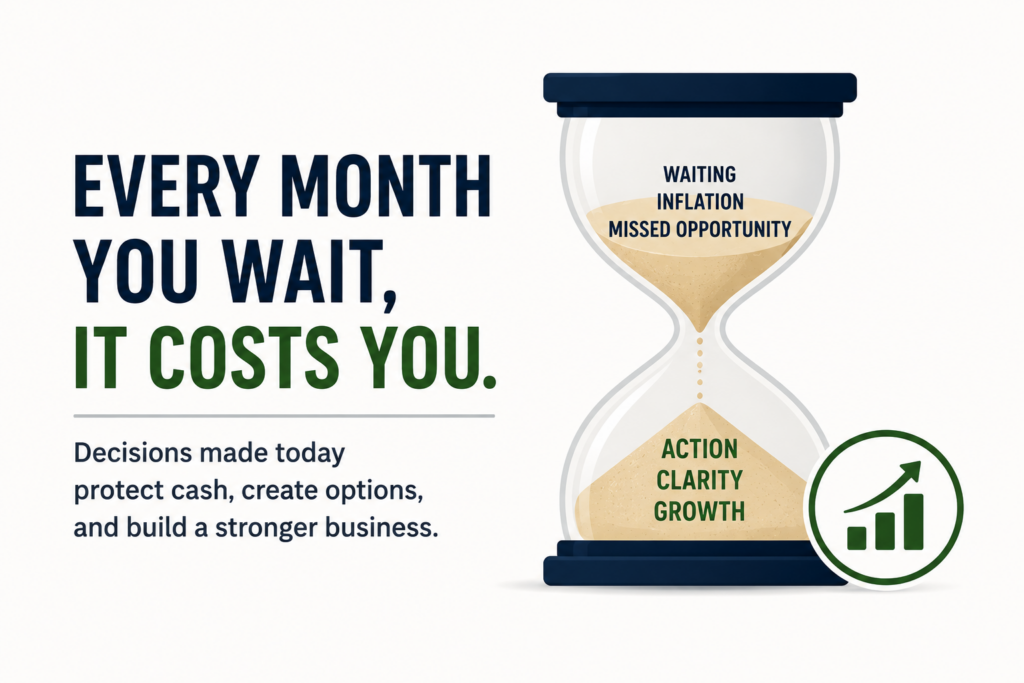
Most businesses do not think about waiting as a financial decision because they fool themselves into feeling it is temporary. It feels like you are avoiding risk until things become clearer. But the business does not stop moving while leadership waits. Employees still come to work, and customers still expect responsiveness. Costs continue rising, and competitors continue adapting. The meter keeps running whether a decision gets made…or not.
Many leaders spend time evaluating the cost of acting. You need to be asking hard questions. Can we afford the hire? Can we afford the investment? Can we afford the additional overhead? For some reason, far fewer spend time evaluating the cost of waiting. And inflation changes the math. Labor and software costs rise. Equipment costs rise and, yes, fuel costs rise too. Decisions that looked super manageable six months ago may carry a very different price tag today.
To be frank, you need to be asking yourself this: What decisions inside your business will cost materially more six months from now if you continue waiting?
A Real-Time Example: Pricing
Pricing is a good example. Right now, many business owners are looking hard at pricing. Costs are up. Competitors are raising prices. Customers are feeling inflation too.
So what do you do?
Do you raise prices because your costs have increased? Do you hold pricing because you are concerned customers may push back? Or are you looking at pricing simply because competitors are doing it?
Those are real questions right now.
When the Obvious Decision Is Not So Obvious
And sometimes the decisions get even harder. Let me describe what Ken Keller calls the “internal terrorist” problem that some companies face. I was part of a leadership team bringing long-needed change to an organization that had become stuck in the past. The phrase transformational change gets overused, but in this case it fit. Many long-tenured employees were resistant and did real damage in their effort to fight change. They were also on year-to-year contracts, so non-renewal seemed like the obvious solution on paper. Find replacements and move on.
But it was not that simple.
Those same employees had deep customer relationships and a great deal of trust with clients. Moving too aggressively created real risk. Waiting created risk too because the resistance to change remained in place. Rock met hard place.
That is where leadership gets tested. Sometimes acting carries risk. Sometimes waiting carries risk. And sometimes neither option feels clean.
The Cost That Builds Quietly
That same tension shows up every day inside privately held businesses.
What makes this all the more complicated is that the financial cost of waiting rarely shows up all at once. Margins tighten a little. Pricing falls behind rising costs. Employees spend more time working around things that should have been addressed months earlier. Then one day something that felt manageable starts feeling expensive.
A Better Question to Ask
That is why this question matters: What is waiting costing us every month?
That does not automatically mean act now. Sometimes waiting is exactly the right call. Sometimes slowing down matters. Sometimes more information matters. But that should still be intentional. Waiting should not happen just because uncertainty feels uncomfortable or because the hard decision keeps getting pushed to next month.
That is where financial leadership matters. Not simply reporting what already happened. Not simply closing the books. But helping leadership understand what each path may cost before the decision gets made.
Sometimes moving too quickly creates unnecessary risk. Sometimes waiting protects the business. And sometimes waiting feels safer while quietly becoming the more expensive decision.
That matters.